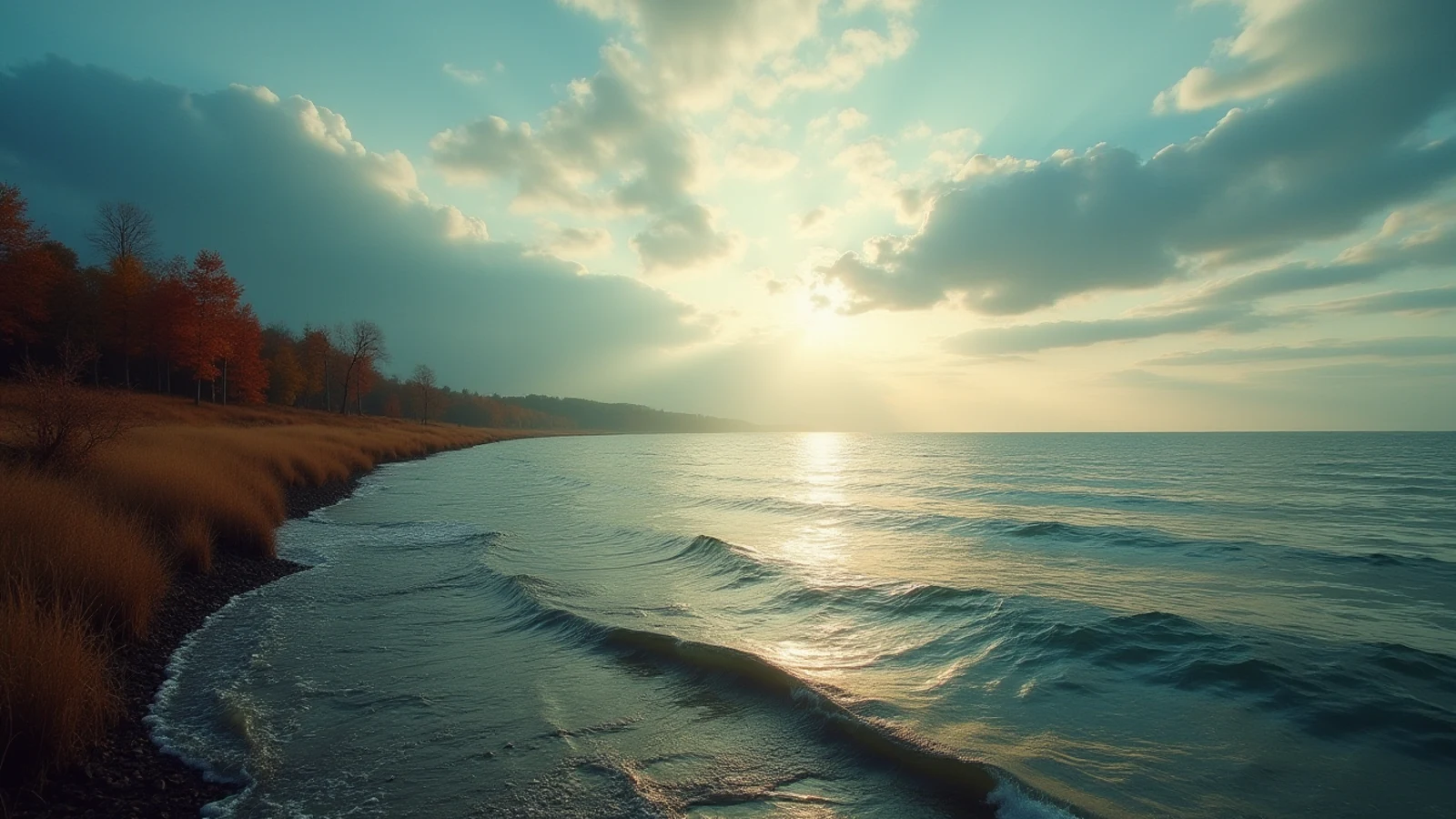
shoreline · Lake Superior
Great Lakes Lighthouses Worth the Detour
The Great Lakes hold more lighthouses than any coastline in America. These are the ones worth building a trip around, and what makes each one different.
Before radar, a freighter running the length of Lake Superior in November had two ways to know where it was: dead reckoning and a light on a rock. The United States built lighthouses on these lakes faster than on either ocean coast, because the shipping was worth more and the weather was worse. More than 300 still stand.
Most of them are worth a stop. These are worth a detour.
Split Rock, Lake Superior, Minnesota
The most photographed lighthouse in America sits on a 130-foot cliff of anorthosite above the North Shore, 20 miles up from Two Harbors. It exists because of one night: the November 1905 gale that wrecked or stranded 29 ships on Superior, including the Madeira directly below the site. Congress funded the station, and because there was no road, every stone and every piece of the third-order Fresnel lens came up the cliff by derrick.
The light went into service in 1910 and was decommissioned in 1969, superseded by radar. It is now a Minnesota state park and history center, and the tower, the keeper’s houses, and the fog signal building are all preserved. Go in October when the birch behind it turns, or on the anniversary of the 1975 Edmund Fitzgerald sinking, when the light is lit ceremonially.
Big Sable Point, Lake Michigan, Michigan
A black-and-white banded tower standing alone on open beach north of Ludington, 112 feet tall and reachable only by a two-mile walk through Ludington State Park. There is no parking lot at the light. That walk is the whole reason to go: the dunes on one side, the lake on the other, and the tower getting slowly larger for forty minutes.
The brick tower was encased in steel plate in 1900 because Lake Michigan weather was destroying the masonry. You can climb it in season. Little Sable Point, 30 miles south at Silver Lake, is its bare-brick sibling — no keeper’s house, no outbuildings, just a red tower on sand.
Point Betsie, Lake Michigan, Michigan
Just south of Sleeping Bear, Point Betsie marks the turn into the Manitou Passage, one of the busiest and most dangerous shipping lanes on the lake. It is the classic white-tower-and-red-roof image of a Great Lakes light, sitting directly on the beach with waves breaking against its seawall.
Point Betsie’s fog signal ran on steam, then on diesel, and its keepers were among the last on Lake Michigan — it was not automated until 1983.
Old Mackinac Point, Straits of Mackinac, Michigan
At the point where Lake Michigan and Lake Huron meet, in the shadow of the Mackinac Bridge, sits a cream-brick castle of a lighthouse built in 1892. The Straits are the hinge of the entire system, and before the bridge every ferry, freighter, and passenger boat funneled through them.
It is a museum now, restored to its 1910 appearance, and it is a rare chance to see how a keeper’s family actually lived: the kitchen, the parlor, the fog signal whistle that ran for days on end in a straits fog.
Round Island, Straits of Mackinac, Michigan
Visible from every ferry between Mackinaw City and Mackinac Island: a red-and-white wooden lighthouse standing on an undeveloped island, alone. It was abandoned in 1947 and half of it collapsed in a 1972 storm. Volunteers rebuilt it. There is no dock and no public landing — you see it from the water, which is exactly how it was meant to be seen.
Whitefish Point, Lake Superior, Michigan
The oldest continuously operating light on Lake Superior, at the eastern end of the lake where every ship turns to enter the relative safety of Whitefish Bay. The stretch of water off this point is called the Graveyard of the Great Lakes, and more than 200 vessels have gone down within its reach.
The Great Lakes Shipwreck Museum sits on the site, and it holds the recovered bell of the Edmund Fitzgerald, which sank 17 miles northwest on 10 November 1975 while running for the shelter of this exact point. The skeletal steel tower is not beautiful. Standing on that beach in a November northwest gale explains the entire history of Great Lakes shipping.
Presque Isle, Lake Huron, Michigan
Two lights north of Alpena, an old one from 1840 and a new one from 1870 that stands 113 feet and is among the tallest towers you can climb on the lakes. The view from the top runs out over Lake Huron and the northern edge of the Thunder Bay National Marine Sanctuary, where nearly 100 wrecks lie in cold, clear, fresh water.
The area around Presque Isle is dark-sky country. Come for the light, stay for the stars.
Marblehead, Lake Erie, Ohio
The oldest continuously operating lighthouse on the American side of the Great Lakes, lit in 1822 and still running. It sits on a limestone point at the east end of the Marblehead Peninsula, looking across at Kelleys Island and South Bass. It is a squat, thick-walled tower — Erie’s weather does not reward elegance — and it is surrounded by an Ohio state park.
Come in early June when the walleye boats are running past it before dawn.
Thirty Mile Point, Lake Ontario, New York
Between Olcott and Wilson on Lake Ontario’s south shore, a stone tower and attached keeper’s house sit in Golden Hill State Park, named for the distance from the Niagara River. The station opened in 1876 after the wreck of the schooner HMS Ontario. The keeper’s quarters can be rented.
Lake Ontario’s lights are less famous than Superior’s, and it is a quieter shoreline in every sense. That is the appeal.
How to visit them well
Check season and access. Most Great Lakes lights are staffed by volunteers and open from Memorial Day to mid-October at best. Some open only on weekends. A few — Round Island, several offshore cribs — cannot be landed at all.
The weather makes the picture. A calm blue afternoon flattens these places. Go on a day with wind on the shore, and stay for the last hour of light.
Piers are not sidewalks. Pier lights at Grand Haven, St. Joseph, and Manistee sit at the end of long concrete walkways with no railings. Waves break over them in any onshore blow and people are killed doing this. If the water is moving at all, photograph from the beach.
Support the keepers. Almost every one of these towers stands because a local historical society took it over when the federal government stopped paying for it. The five-dollar climb fee is the whole budget.
Keep exploring
More from the field guide
Questions
- How many lighthouses are on the Great Lakes?
- Somewhere over 300 standing light stations across the American and Canadian shores, more than any other coastline in North America. Michigan alone has more than 120, the most of any state in the country.
- Can you stay overnight in a Great Lakes lighthouse?
- Several run keeper programs where volunteers live on site for a week at a time, and a few operate as bed and breakfasts. Big Bay Point on Lake Superior and Sand Hills near Eagle Harbor are among the best known. They book far in advance.
- What is the oldest lighthouse on the Great Lakes?
- Several stations date to the 1810s and 1820s, including Fort Niagara and Presque Isle. Most towers standing today are later rebuilds on the original sites, because early Great Lakes lights were built fast and cheap and did not survive the weather.
- Are Great Lakes lighthouses still working?
- Most are still active aids to navigation, now automated with modern optics. The Coast Guard maintains the light; the buildings themselves have largely been transferred to nonprofits, historical societies, and park agencies that keep them standing.
Read next
Where to Swim: Great Lakes Beaches and the Currents Nobody Warns You About
The best swimming beaches on the Great Lakes, and how rip, structural, and channel currents form, how to spot them, and how to get out.
The Lake Michigan Dune Coast: A Shoreline Drive Worth Taking
The eastern Lake Michigan shore from the Indiana Dunes to Sleeping Bear: the parks, towns, and climbs that make it the best drive on the lakes.