almanac · Lake Huron
The Shipwrecks of Thunder Bay, and Why Lake Huron Keeps Them
Nearly 100 wrecks lie off Alpena in Lake Huron. Why cold fresh water preserves wooden ships that salt water would have erased a century ago.
In the ocean, a wooden ship is gone in a decade. A mollusk called the shipworm — not a worm at all, but a clam with a boring shell — tunnels through submerged timber and consumes it. Salt water also carries more oxygen-driven corrosion and more biological activity. What survives a century in the Atlantic is usually iron, ballast stone, and cargo.
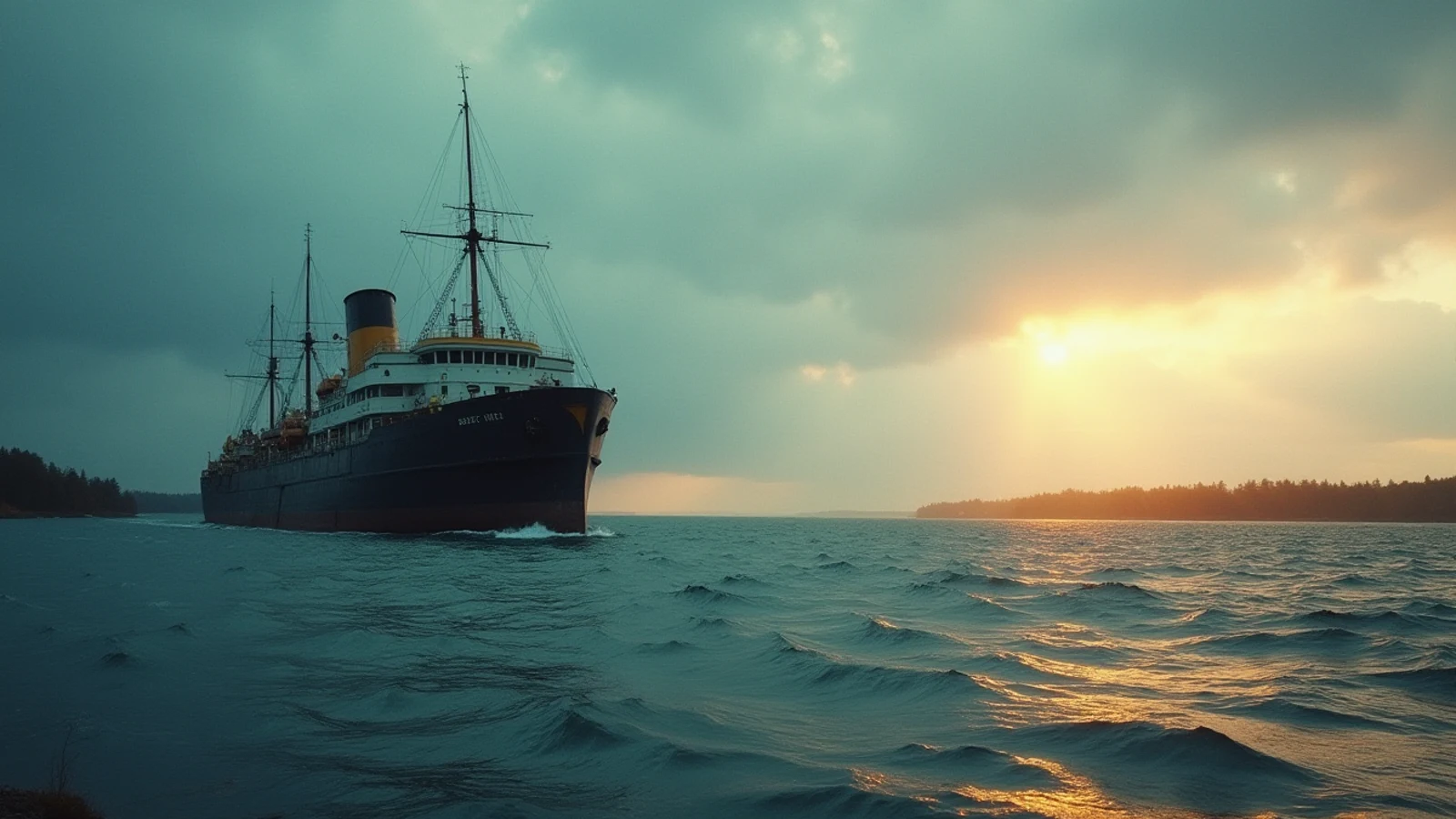
In Lake Huron, a schooner that went down in 1894 is still a schooner. Deck planking, capstan, windlass, sometimes masts standing upright in 150 feet of water with rigging attached. Divers describe swimming over cargo still stacked in the hold.
That difference is the whole reason Thunder Bay exists as a national marine sanctuary.
Why the lakes keep their dead
Three conditions do it.
No shipworm. Teredo navalis and its relatives cannot survive in fresh water. The single most destructive force acting on wooden wrecks in the ocean is simply absent here.
Cold. Lake Huron averages 195 feet deep and its deep water stays in the 30s and low 40s year-round. Chemical and biological decay processes roughly halve in rate for every ten degrees of cooling. A wreck in 150 feet of Huron water is sitting in a refrigerator.
Low light and low oxygen at depth. Below the thermocline there is no sunlight, minimal algal growth, and less dissolved oxygen than at the surface. Iron corrodes slowly. Fabric, rope, and even paper have been recovered in recognizable condition.
The shallow wrecks tell the other half of the story. In under 30 feet, ice scour, storm waves, and a century of surface energy break hulls apart and scatter them across the bottom. Thunder Bay has both kinds — broken and beautiful in the shallows, eerily whole in the deep — and that range is exactly why researchers value the site.
Why so many ships died here
Thunder Bay sits on the western shore of Lake Huron, north of Saginaw Bay, at a spot where every ship moving between the upper lakes and the lower ones had to pass. Traffic was enormous: lumber south, iron ore and grain down from Superior, coal and manufactured goods back up.
The bay itself is a trap. Shoals and limestone reefs extend well offshore, and Thunder Bay Island and Sugar Island sit exactly where a vessel running for shelter in a northeast gale would try to go. Fog is common — the same cold water that preserves the wrecks makes it — and 19th-century navigation was compass, lead line, and a lookout.
Add November. The Great Lakes storm season lands when the water is still warm and the air is not, and the resulting systems produce sustained gales that have destroyed steel freighters, let alone wooden schooners loaded past their marks by owners paid on tonnage.
The result is a graveyard covering more than a century: sidewheel steamers, three-masted schooners, wooden bulk carriers, steel freighters, and at least one 20th-century ship that simply broke in half.
The wrecks people come for
The Nordmeer, a German steel freighter that ran onto a shoal in 1966. Parts of it stood above the surface for decades. It is the sanctuary’s most accessible wreck, snorkelable in good conditions.
The Cornelia B. Windiate, a three-masted schooner that vanished in 1875 with all hands. She was found in 1986 sitting upright and intact in about 185 feet of water, all three masts standing, her yawl boat still tied astern. Nobody knows what happened. She looks ready to sail.
The Pewabic, a passenger and freight steamer that collided with her sister ship in 1865 with heavy loss of life. Salvage attempts over the following decades killed additional divers. She lies deep and is a technical dive.
The Portland, the Shamrock, the E.B. Allen — a long list of wooden schooners in the 40- to 100-foot range that make Thunder Bay one of the best sport diving destinations in North America.
The Monrovia, the Montana, the Grecian — steel and iron ships that show what a century in fresh water does to metal, which is much less than you would guess.
Seeing them
You do not need to dive.
The Great Lakes Maritime Heritage Center in Alpena is the sanctuary’s visitor center and is free. It holds a full-scale schooner section, recovered artifacts, and the story of the survey work that continues to find new wrecks with side-scan sonar and remotely operated vehicles.
Glass-bottom boat tours run out of Alpena in the summer season and pass over several shallow wrecks. On a flat, clear day the visibility in Thunder Bay is remarkable.
Kayak and snorkel access exists for the shallowest sites, and the sanctuary publishes locations. Thunder Bay is genuinely calm on a good morning and genuinely dangerous when the wind comes up — check the marine forecast before paddling anywhere near open water.
Diving requires the usual planning and, for the deep wrecks, technical training and gas. Charters operate out of Alpena all summer.
The rules, and why they matter
Thunder Bay was designated in 2000 as the first national marine sanctuary in the Great Lakes, and it was expanded in 2014 to 4,300 square miles. That protection exists because the wrecks are archaeological sites, and unlike ocean wrecks they are effectively complete.
Removing artifacts is prohibited. Anchoring on a wreck is prohibited — mooring buoys are provided in season. Penetration diving is regulated. These are not bureaucratic rules; a schooner that has sat intact for 140 years can be materially damaged by one careless anchor.
The larger picture
There are an estimated 6,000 shipwrecks across the Great Lakes, with perhaps 30,000 lives lost. Michigan alone protects thirteen underwater preserves. Whitefish Point on Superior holds the Edmund Fitzgerald and 200 others. The Straits of Mackinac, Isle Royale, and the Manitou Passage all hold their own fields.
Thunder Bay is not the largest of these. It is the one where you can most clearly see what the Great Lakes actually are: cold, deep, indifferent, and unusually good at keeping a record.
Our Great Lakes shipwreck directory charts the wrecks with a documented record, lake by lake, and the Lake Huron list covers Thunder Bay and the rest of the lake.
Questions
- How many shipwrecks are in Thunder Bay?
- NOAA's Thunder Bay National Marine Sanctuary protects an area off Alpena, Michigan where nearly 100 wrecks have been located, and the historical record suggests roughly 200 vessels were lost in the area. Discoveries are still being made.
- Why are Great Lakes shipwrecks so well preserved?
- Fresh water has no shipworm, the mollusk that eats wooden hulls in the ocean within a few years. The water is also cold and, in the deep, dark and low in oxygen. Together those conditions slow decay so much that 19th-century wooden schooners still stand upright with masts and rigging in place.
- Can you see Thunder Bay shipwrecks without diving?
- Yes. Several wrecks lie in shallow water visible from the surface, and glass-bottom boat tours run out of Alpena in summer. Kayakers can paddle over wrecks in Thunder Bay's shallows on a calm clear day.
- What is the most famous Great Lakes shipwreck?
- The Edmund Fitzgerald, which sank in Lake Superior on 10 November 1975 with all 29 hands, is the best known. Thunder Bay's wrecks are less famous individually and far more numerous, and they cover a century and a half of Great Lakes commerce.
Read next
The Alewife, the Sea Lamprey, and How the Salmon Fishery Was Invented
Two invasive species wrecked the Great Lakes food web, and a Michigan biologist answered with Pacific salmon. The history behind every charter boat here.